
Authors: John D. Rogers, Harlan R. Sayles, and Richard H. Legge
Published: Cureus. 2026 Jul 27. doi: 10.7759/cureus.113466
Main Research Question
How prepared are pediatricians to recognize possible visual difficulties related to CVI, and what could make screening easier and more realistic during routine pediatric visits?
They were particularly interested in children with neurological conditions because this group has a higher risk of CVI.
Background Context
Cerebral/cortical visual impairment (CVI) is a vision condition caused by the brain having difficulty processing visual information. Unlike many common vision problems, CVI is not primarily caused by an issue with the eyes. A child may have healthy-looking eyes and still have trouble understanding what they see.
One way to picture CVI is to think of the visual system as a camera connected to a computer. The camera may capture a clear picture, but if the computer has trouble processing the information, the picture may not make sense. Similarly, a child with CVI may see an object but have difficulty recognizing it, finding it in a busy environment, or understanding what they are looking at.
CVI is especially important for children with neurological conditions because they are at greater risk. Despite being a major cause of childhood visual impairment, CVI is often overlooked or diagnosed late. The article notes that the average age of diagnosis is approximately 4.6 years. Delayed recognition can prevent children from receiving appropriate educational support, therapies, and other services during important stages of development.
Pediatricians are in a particularly important position because families often see them regularly throughout their childhood. However, there are limited recommendations specifically addressing how pediatricians should screen for CVI. This study examined whether pediatricians have enough CVI education, how often they look for visual difficulties in children with neurological conditions, how they make referrals, and what type of screening tool they would realistically use.
Methodology
The researchers developed a 60-question survey covering pediatricians' professional backgrounds, CVI education, visual screening habits, referral practices, and opinions about potential screening tools.
The survey was emailed to all 396 licensed pediatricians in Nebraska. Responses were collected between March and December 2025. A total of 89 pediatricians responded, representing approximately 22.5% of those invited.
The survey included several types of questions, including multiple-choice questions, questions asking participants to select all applicable answers, rating-scale questions, and open-ended responses.
Pediatricians were asked about different hypothetical screening tools. Some were designed to take two minutes or less, while others required four or eight minutes. The researchers also asked whether pediatricians would be willing to use a free screening application on a phone or tablet.
The researchers summarized the responses using basic statistics, including frequencies and percentages. Importantly, the survey was not formally validated before it was distributed, and the researchers relied on what pediatricians reported about their own practices rather than directly observing clinical visits.
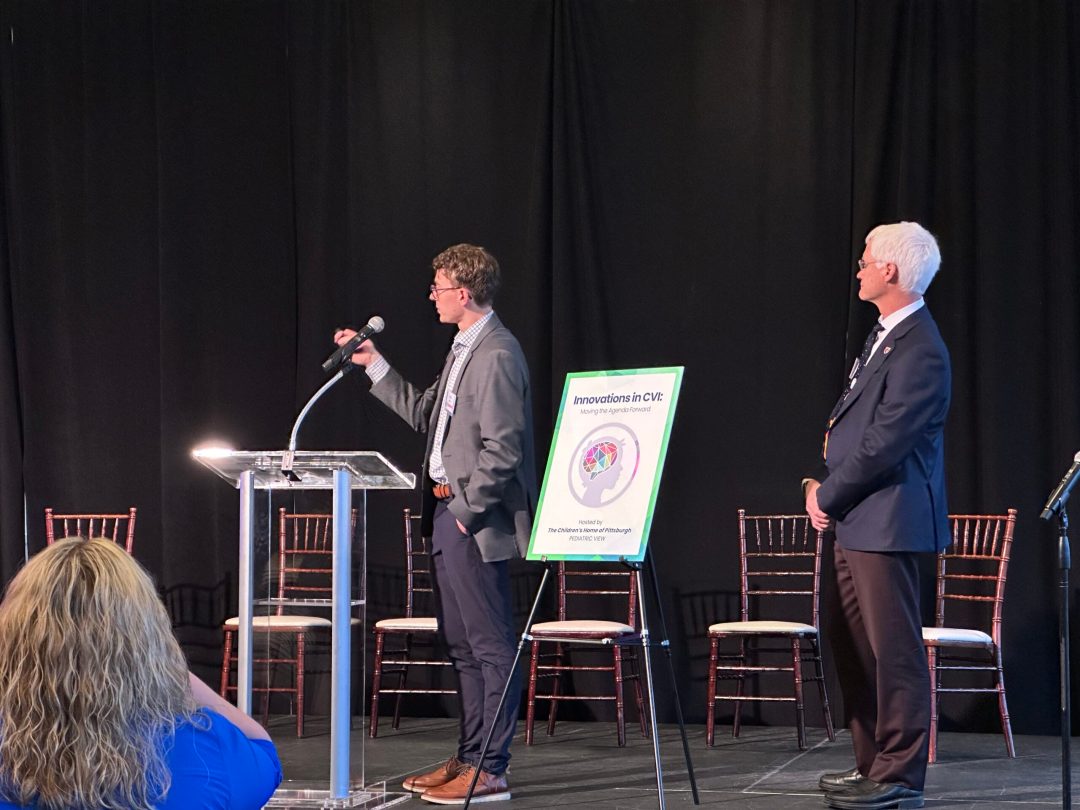
Image Description: Paper authors John Rogers and Richard Legge, MD, present from the stage at the 2025 Innovations in CVI Conference in Pittsburgh.
Key Findings
Limited CVI education
The most striking finding was the lack of formal CVI education among the pediatricians surveyed.
About 89% said they had never attended a CVI lecture or conference during residency or fellowship. Similarly, nearly 87% had never attended a CVI lecture as part of continuing medical education.
This lack of education was reflected in the participants' familiarity with CVI. More than half did not know what the abbreviation "CVI" meant, and approximately 96% were unaware of the diagnostic criteria used to identify CVI. Nearly 98% said they were unable to diagnose CVI.
For parents and educators, this finding is important because a child's visual difficulties may not always look like a traditional eye-sight problem. Without familiarity with CVI, a pediatrician may not recognize that behaviors such as difficulty locating objects, becoming overwhelmed in visually busy settings, or responding inconsistently to visual information could warrant further evaluation.
Screening was inconsistent
Approximately 67% of respondents said they screened children with neurological conditions for visual dysfunction in some way. However, screening was not happening consistently. About 41% reported screening these children less than 25% of the time.
When pediatricians did screen, they mostly asked parents about concerns or used a physical examination. Only about 17% reported using formal vision screening tools.
It is important to clarify that the study measured screening for visual dysfunction, not direct screening for CVI. Still, because children with neurological conditions are at increased risk for CVI, checking visual difficulties could provide an important first step toward identifying children who need a more complete evaluation.
Pediatricians preferred very short screening tools
Time was another major issue.
About 60% of pediatricians said they would use a screening tool at least 75% of the time if it contained three or fewer questions and took no more than two minutes. Approximately 65% expressed the same level of intended use for a tool involving two questions and one physical examination component that could also be completed within two minutes.
Interest dropped considerably as the screening became longer. Only about 27% said they would use a tool of up to five questions requiring four minutes or less at least 75% of the time. That figure fell to about 11% for a tool with up to 10 questions taking as long as eight minutes.
This finding highlights a simple reality of pediatric care: a screening tool can be useful only if healthcare providers have time to use it. The researchers' results suggest that CVI screening needs to be more like a quick safety check than a lengthy examination.
Technology could make screening more appealing
The survey also explored the possibility of a mobile screening application. About 87% of respondents said they would be somewhat or highly likely to use a free application on a phone or tablet if it could be completed in five minutes or less.
This does not prove that a mobile app would increase screening. The researchers point out that the mobile option differed from the other scenarios in several ways, so they could not determine whether the device itself was responsible for the interest.
Still, the finding suggests that convenience and accessibility could play a role in encouraging pediatricians to screen more often.
Referral practices varied
When asked where they would refer a child with a positive screening result, pediatricians most frequently selected a pediatric ophthalmologist. Other common choices included pediatric neuro-ophthalmologists, pediatric neurologists, and ophthalmologists.
Only about 6% selected a neuro-optometrist, even though professionals in this area can contribute to CVI diagnosis and care.
The variety of referral choices may reflect the complex nature of CVI. Understanding a child's visual difficulties can require input from several professionals rather than one specialist working alone. The findings also suggest that some pediatricians may be uncertain about the best referral pathway for a child suspected of having CVI.
Significance and CVI Implications
The study's most important message is that earlier recognition of CVI may depend partly on improving awareness among the healthcare professionals who see children first.
Better CVI education could help pediatricians recognize warning signs and know when a child should receive additional evaluation. Pediatricians do not necessarily need to diagnose CVI themselves. Instead, they need enough knowledge to recognize that a child's visual behavior may be unusual, and that further assessment is appropriate.
This is especially relevant for parents and educators. Children with CVI can sometimes be misunderstood because their visual challenges do not always resemble conventional eyesight problems. A child may appear to "see fine" in one situation but struggle significantly in another. Recognizing that the difficulty may involve how the brain interprets visual information can change how adults understand and support the child.
The study also emphasizes the importance of creating screening methods that fit into real-world healthcare. If a screening process takes only a couple of minutes, pediatricians may be much more willing to use it. A simple tool could therefore serve as an early warning system, helping identify children who might otherwise go unnoticed.
However, the study does not demonstrate that these strategies will result in earlier diagnosis. The researchers measured pediatricians' reported behaviors and intended use of hypothetical tools. Additional research is needed to determine whether education and brief screening tools change what happens in actual clinical practice.
Main Conclusions
The researchers found that pediatricians surveyed in Nebraska had limited education and awareness regarding CVI and reported inconsistent screening for visual difficulties among children with neurological conditions.
At the same time, there was considerable interest in additional CVI education. This suggests an opportunity to strengthen training during residency, fellowship, and continuing medical education.
The study also found that pediatricians were much more interested in short screening tools, particularly those requiring two minutes or less. A free mobile application also received strong interest, although its effectiveness remains unknown.
For families and educators, the broader lesson is that CVI can be easy to miss when visual behavior is not recognized as a potential sign of a brain-based vision problem. Increasing awareness among pediatricians could help connect children to appropriate evaluations and support sooner.
Key Takeaways
- CVI is different from ordinary eyesight problems. A child may have relatively healthy eyes but still have difficulty interpreting visual information.
- CVI is often underrecognized. Limited awareness among healthcare providers may contribute to delayed identification.
- Children with neurological conditions deserve particular attention. They are at increased risk for CVI, making visual screening an important consideration.
- Pediatrician education matters. Most participants had little or no formal education about CVI.
- Brief screening is more practical. Pediatricians showed much greater interest in tools that could be completed in two minutes or less.
- Technology may help. Many respondents expressed interest in a free mobile screening application.
- CVI care is multidisciplinary. Children may need assessment and support from ophthalmology, neurology, optometry, therapy, education, and other professionals.
- Parents and educators can play an important role. Their observations about a child's everyday visual behavior may provide valuable information for healthcare providers.
- More research is needed. The next step is determining whether better education and brief screening tools actually lead to more screening and earlier CVI diagnosis.
Overall Summary
Rogers and colleagues' study highlights a gap but also points toward a possible solution. Pediatricians may be willing to look more carefully for CVI if they receive better education and have screening tools that are quick and easy to use. For children and families, that combination could eventually mean earlier recognition, better understanding of visual needs, and faster access to appropriate educational and therapeutic support.
Rogers JD, Sayles HR, Legge RH. The Education, Screening, and Referral Practices of Pediatricians Surrounding Cerebral/Cortical Visual Impairment. Cureus. 2026 Jul 27;18(7):e113466. doi: 10.7759/cureus.11346. PMID: 42548613; PMCID: PMC13429519.